What is an LR44 Battery Equivalent?
The term LR44 Battery Equivalent is widely searched because many people encounter this small button cell in everyday devices but find multiple different codes printed on packaging, which creates confusion. The LR44 battery is a compact alkaline button cell commonly used in small electronics, and its “equivalent” refers to other batteries that share the same size and voltage characteristics but may differ slightly in chemistry, branding, or performance.
In simple terms, when someone refers to an LR44 equivalent, they are talking about interchangeable batteries that can replace LR44 in most devices without causing damage or malfunction. These equivalents are important because LR44 is sold under many names worldwide, and manufacturers often label the same battery differently depending on region or standards.
Understanding LR44 Battery Basics and Chemistry
The LR44 Battery Equivalent is a 1.5-volt alkaline button cell, which means it uses an alkaline chemical composition to generate electrical energy. Inside the small metal casing, a chemical reaction between zinc and manganese dioxide produces a steady voltage output. The “LR” in LR44 refers to alkaline chemistry under the International Electrotechnical Commission (IEC) naming system, while the number 44 identifies its size category.
Although it is small in appearance, the LR44 battery is designed to deliver consistent low-drain power over a reasonable period. It is not rechargeable, and once depleted, it must be replaced. The chemistry plays a major role in determining its performance characteristics, such as discharge rate and shelf life.
Common LR44 Equivalent Names Across Brands
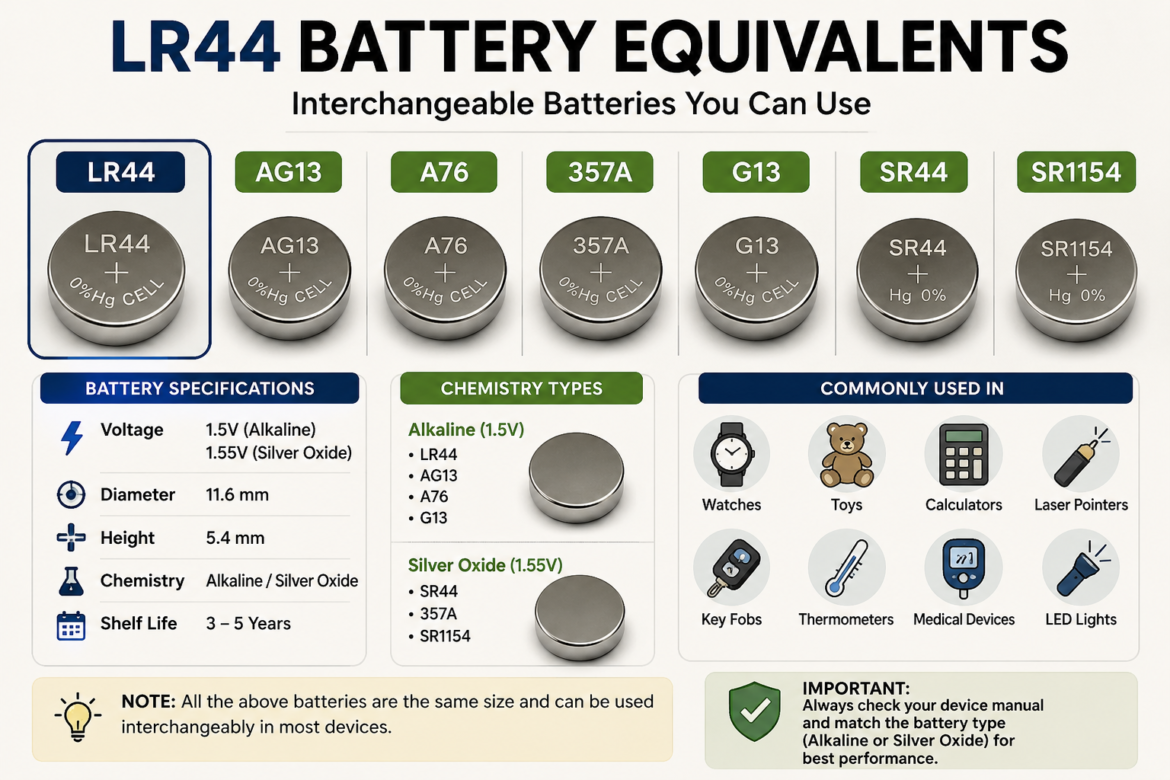
One of the main reasons people search for LR44 battery equivalents is that this single battery type is sold under many different naming conventions. Depending on the manufacturer or region, LR44 may also be labeled as AG13, A76, 357A, or G13. These names often confuse, but they generally refer to the same physical size and voltage output. For example, AG13 is a very common commercial label used in toys and small gadgets, while A76 is frequently used in American retail packaging.
In some cases, the SR44 designation may also appear, but this typically refers to a silver oxide version rather than alkaline. Despite the different names, most of these batteries can physically fit and operate in the same devices, which is why they are considered equivalents. However, subtle differences in chemistry can slightly affect performance, especially in precision electronics like watches or medical instruments.
Size and Physical Specifications Comparison
The LR44 Battery Equivalent follows a standardized size that makes it interchangeable with its equivalents. It typically measures about 11.6 mm in diameter and 5.4 mm in height, which is why it falls into the “44” size category in its naming system. This consistent sizing is crucial because even a slight variation could prevent the battery from fitting into compact electronic compartments.
The LR44 Battery Equivalent and its equivalents, such as AG13 and A76, all share this exact physical dimension, ensuring compatibility across a wide range of devices. The flat, coin-like structure allows manufacturers to design slim gadgets without compromising power needs. Even though different brands may package these batteries differently, the internal size standard remains the same.
Voltage Differences Between Alkaline and Silver Oxide Types
While LR44 and its equivalents may look identical in size, not all of them deliver the same type of voltage behavior. Standard LR44 Battery Equivalent are alkaline and provide a nominal voltage of 1.5 volts, but silver oxide equivalents like SR44 or 357 typically provide a more stable 1.55 volts. This small difference might seem insignificant, but in precision devices such as analog watches or medical instruments, it can make a noticeable difference in performance.
Alkaline versions tend to discharge more gradually, meaning the voltage drops steadily over time, while silver oxide versions maintain a more consistent output until near depletion. Because of this, silver oxide equivalents are often preferred for devices requiring accuracy, whereas alkaline LR44 batteries are commonly used in toys, calculators, and basic electronics.
Devices That Commonly Use LR44 Batteries
LR44 Battery Equivalent and their equivalents are found in a surprisingly wide range of everyday devices, which is one of the reasons they are so widely stocked. These batteries are commonly used in small digital thermometers, wristwatches, laser pointers, LED keychain lights, children’s electronic toys, and compact calculators.
In medical tools like glucose meters and digital thermometers, LR44 Battery Equivalent are often chosen because they provide reliable short-term energy bursts. In toys, they power lights, sounds, and simple motors. Because these devices are often designed globally, manufacturers typically accept multiple equivalent codes to simplify battery replacement.
Can You Replace LR44 with SR44 or 357 Batteries?
A common question among users is whether LR44 Battery Equivalent can be replaced with SR44 or 357 equivalents, and the answer is generally yes, but with some important considerations. SR44 and 357 batteries are silver oxide versions, which means they offer more stable voltage output and usually longer life compared to alkaline LR44 batteries.
Physically, they are the same size and fit perfectly into devices designed for LR44 cells. However, because they maintain voltage more consistently, they may slightly improve the performance of sensitive devices. In most everyday electronics like toys or small gadgets, the difference is not noticeable, and replacement is straightforward.
Shelf Life and Performance Differences
Shelf life is another important factor when discussing LR44 battery equivalent, as different chemistries and brands can significantly affect how long a battery remains usable before installation. Alkaline LR44 batteries typically have a shelf life of around three to five years, depending on storage conditions.
Once in use, alkaline batteries tend to show a gradual voltage decline, which can cause devices to dim or behave inconsistently as the battery drains. Silver oxide batteries maintain a steadier voltage until they are nearly depleted, which is why they are preferred in precision applications.
How to Choose the Right LR44 Equivalent
Selecting the correct LR44 Battery Equivalents depends largely on the device requirements and user expectations. If the device is a simple toy, remote control accessory, or basic calculator, an alkaline LR44, AG13, or A76 battery is usually sufficient and cost-effective.
It is also important to check the device manual, as some manufacturers specify whether alkaline or silver oxide is recommended. In many cases, both will physically fit, but performance differences may still matter. Brand quality can also influence performance, as well-made batteries from reputable manufacturers tend to last longer and leak less.
Safety and Handling Considerations for LR44 Batteries
Although LR44 Battery Equivalent are small and commonly used, they still require careful handling to avoid safety issues. These batteries can be hazardous if swallowed, especially for children and pets, due to their size and chemical content. Proper storage is essential, and they should always be kept in a secure container away from direct heat, moisture, or metal objects that could cause short-circuiting.
When replacing batteries, it is important to ensure correct polarity alignment, as inserting them incorrectly can damage the device or cause leakage. Used batteries should be disposed of responsibly at designated recycling points rather than being thrown into regular household waste.
Common Mistakes When Replacing LR44 Batteries
One of the most common mistakes people make when replacing LR44 Battery Equivalent is assuming all equivalents are identical in performance, without considering chemistry differences. While AG13, A76, and LR44 alkaline batteries are interchangeable in most cases, mixing them with silver oxide types without understanding device requirements can lead to unexpected results.
Another frequent mistake is installing batteries incorrectly, especially when multiple cells are stacked in a device, leading to poor contact or malfunction. Users also sometimes replace only one battery in a multi-cell setup instead of replacing all at once, which can reduce efficiency and cause uneven power distribution.
Final Practical Advice on LR44 Battery Equivalent
When dealing with LR44 battery equivalent, the most practical approach is to focus on compatibility, chemistry, and device sensitivity rather than just the label on the packaging. Since LR44, AG13, A76, SR44, and 357 batteries are often interchangeable in size, users have flexibility in choosing replacements, but performance differences still matter in certain cases.
For everyday devices, alkaline versions are usually sufficient and cost-effective, while silver oxide versions provide better stability for precision tools. It is always best to check device recommendations when available, but in most situations, knowing the equivalent names is enough to make a safe and effective replacement.
You May Also Read: Tom Felton